
Therapy and Well Being
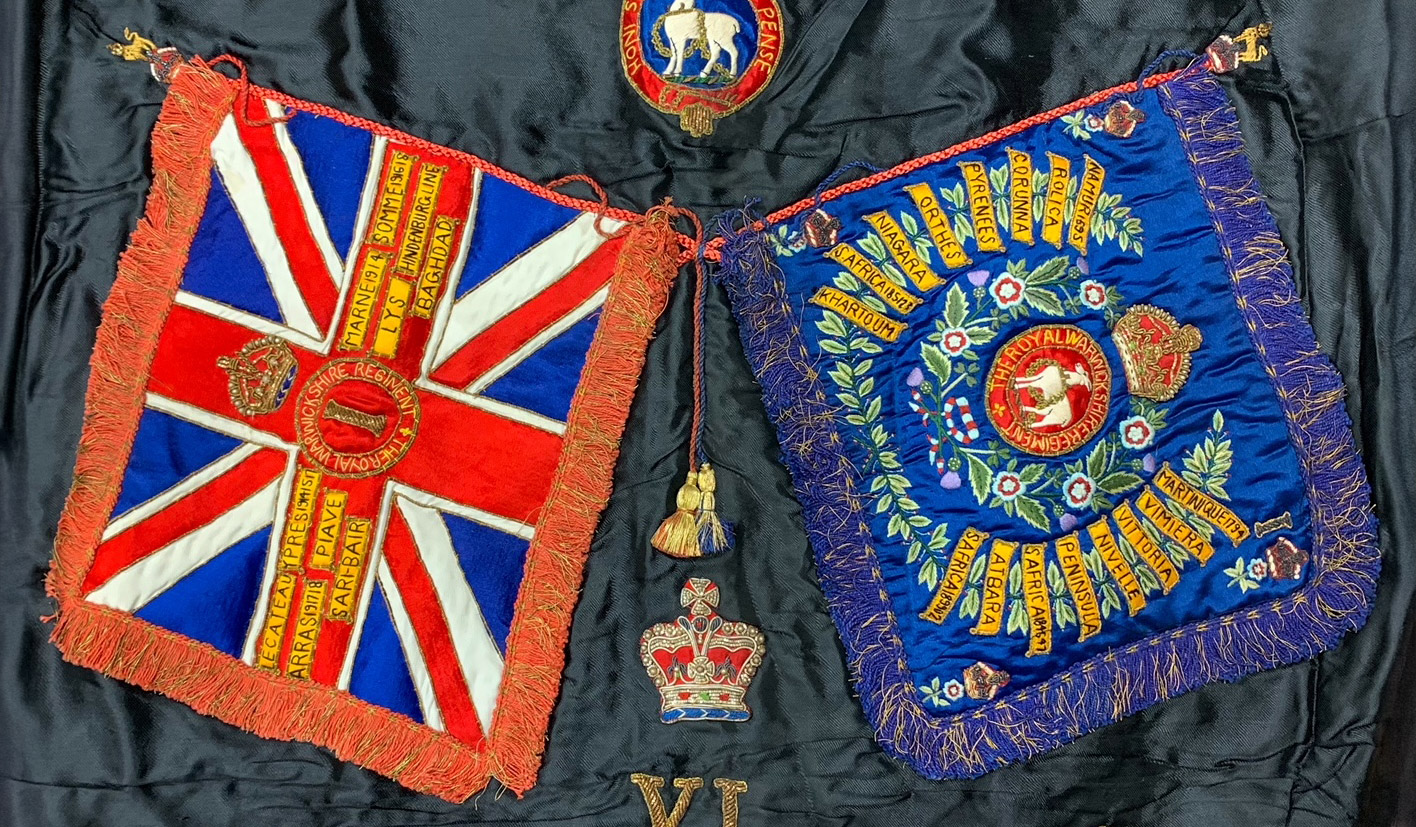
Of the two million combatants in the First World War who were injured, a quarter experienced life-changing injuries and never returned to the frontline. The more severely injured were returned to hospitals in Britain where being confined to bed for extended periods and what we now recognise as Post Traumatic Stress Disorder (PTSD) greatly affected their mental wellbeing. It was generally understood that providing activities for these long-term sick soldiers was beneficial. Embroidery was seen as ideal: it was a quiet activity that could be done anywhere alone or in groups, and it required mental focus to achieve a satisfying result.
Lady Olive Smith-Dorrien D.B.E.
Lady Olive Smith-Dorrien D.B.E. (1881-1951), then the Principal of the Royal School of Needlework, led a group of female volunteers, ‘practical needle women’ with patience and enthusiasm, to support craft activities for injured soldiers to aid peace of mind which was seen as essential to recovery. In an article “On Teaching Convalescents” Lady Smith-Dorrien records that within the first few months of the war there was public recognition of the benefit in setting up ‘handicraft centres’ in hospitals where long-term injured servicemen resided. She stressed the value of embroidery rather than knitting, a more mechanical activity requiring less focus. She instructed her volunteers that:
‘Your first task must be to prove to your patient that needlework is not derogatory to his manhood – Make him understand that thousands of able-bodied men all over England who work hard all day with their brains have, during the last ten years or so, realise that stitching away in the evenings is the very best way of resting their over-tired nerves’.
Image: By Unknown author - The Sketch (January 16, 1918). Public Domain.

Ernest Thesiger
Lady Smith-Dorrien noted many men had become expert embroiderers. Ernest Thesiger (1879-1961) realised the economic potential of this expertise and in 1918 he founded ‘The Disabled Soldiers’ Embroidery Industry’ to provide a means for injured soldiers to earn an income from embroidery skills. Ernest was a famous actor on stage and screen. In 1915 he was wounded while serving in the 9th London Battalion (Queen Victoria’s Rifles). In hospital he saw wounded soldiers doing embroidery and became intrigued. Drawing on his own interest in antique furniture he persuaded disabled soldiers, who were incapable of doing any other work, to stitch articles such as chair covers to restore furniture, and create altar frontals and ecclesiastical vestments. The DSEI had Royal Patronage and eventually received commissions from both the UK and abroad.
Image: Charcoal of Ernest Thesiger by John Singer Sargent, from around 1911. Public Domain.

Louisa Pesel
Louisa Pesel (1870 – 1947) studied decorative stitchery at the Royal College of Art, won awards for her work and became the Director of the Royal Hellenic School of Needlework and Laces. She helped to found what later became the Embroiderer’s Guild. In the First World War, Louisa worked with the Bradford Khaki Handicraft Club for shell-shocked soldiers. In 1920, she became President of the Embroiderers Guild and in the Second World War was involved in assembling embroidery kits for prisoners of war which the Red Cross then distributed.
By the Second World War, stitching kits with transfer paper stamped with templates of regimental badges were ordered by the War Office for each regiment to provide therapeutic activities for injured soldiers.
Austen Albert Ward
In September 1914 at the age of 20 Austen joined the 16th Birmingham Pals Battalion of the 1st Royal Warwickshire Regiment as a private. Just months before the end of the war in 1918, he was severely injured by a bomb when his unit went over the top too early to relieve another battalion in the trenches. Austen lost a bone in one of his lower limbs although luckily did not need to have his leg amputated. During his period of convalescence he created embroidery which is on display here and in the museum. He was honourably discharged out of the regiment on 20th September 1918. As the war was still going on, Austen received the silver war badge to prove he was not a coward or a deserter.


Black velvet tea cosy embroidered by 23273 Private Austen Albert Ward in hospital in 1918.. view more

Cushion cover with red cord edging, embroidered by 23273 Private Austen Albert Ward in hospital in 1918. view more
Bert Shirley
Bert Shirley is recorded as a resident of Balsall Street Coventry in December 1915. In this month he joined the Army Reserve and was then mobilised in April 1916 where he joined the 12th Battalion of the Royal Warwickshire Regiment for training. In August 1916 he was posted to the 3rd Battalion training unit on the Isle of Wight. On the 5th September he embarked for France where he was based at the 29th Infantry Base Depot at Rouen, nominally with the 1st Royal Warwickshire Regiment. On the 12th September Bert joined the 15th Royal Warwickshire Regiment. In May 1917, Bert was wounded in action and taken to the 13 Field Ambulance then 47 General Hospital. On the 18th May he took the Hospital Ship to England. It is presumably during his recovery at Ramsgate hospital in England that he produced his embroidered table mat as therapy. In August 1918 he was appointed Acting Unpaid Lance Corporal in the 3rd RWR at Dover. On 20th December 1918 he overstayed his Christmas leave and was arrested by the Civil Police. He was fined 4 days pay. On the 6th February 1919 he was formally discharged from the army by No 2 Dispersal Unit, Chisledon.


Other Artefacts

With a design showing a regimental garter badge, this may have been a therapy piece.. view more

Penelope was a company well known for producing embroidery packs.. view more

Embroidery of garter badge of the Royal Warwickshire Regiment made as a therapeutic piece by Sergeant W.J. Lyons of the 7th Battalion, Royal Warwickshire Regiment.. view more

Regimental Cap Badge embroidered in silk on black satin by Private 19901 J. Plummer. view more

Woolwork panel on canvas with RWR antelope badge in the centre above "1/7th Battalion" and 50 Division badge.. view more